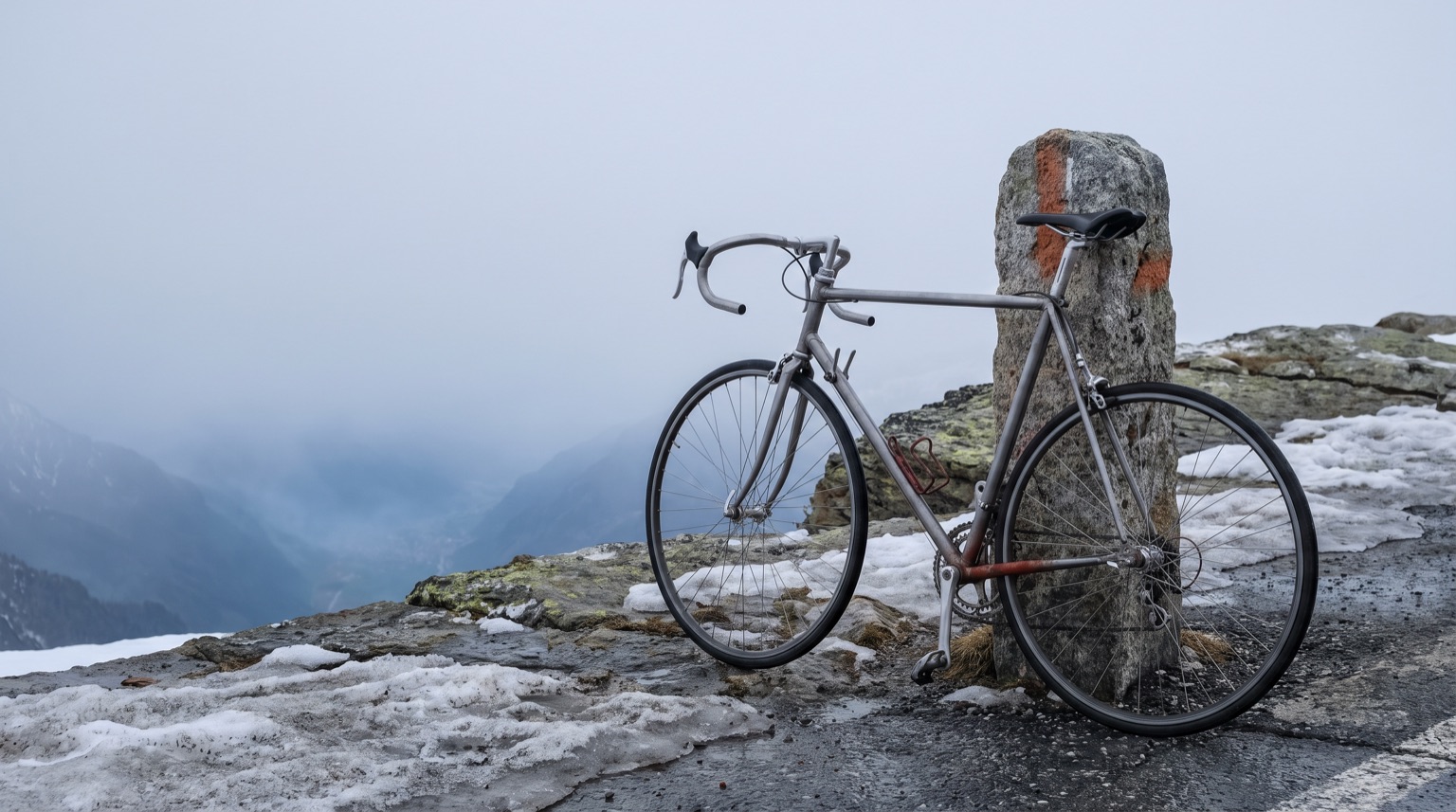
A plain steel road bicycle leaned against a stone snow-marker post at the top of an alpine pass, patches of old snow, the valley falling away into cloud behind.

A frame is a set of angles argued from one rider and one road.

One bench in Edolo, high Val Camonica, under the Mortirolo. The road decides more of this frame than you do.

Traccia · telai su misura dal 1978Edolo, Val Camonica — 690 mAttesa 14 settimane
Pendenza10,5 % media · 18 % maxMortirolo, Mazzo side — 12,4 km

The road writes the specification. The bench only executes it.

Twelve kilometres at ten and a half per cent, with a kilometre at eighteen. That is not a detail about the scenery. It is the document the frame is built from.

A gradient that steep decides the gearing, and the gearing decides the chainstay. A descent that long decides how much trail the fork needs before the front end will hold a line at seventy. Two hours of braking on a wet hairpin decides which steel goes in the down tube. None of that is taste.

He rides every frame he builds up this valley before it is painted, in the weather it will live in. Frames that come back from that ride and get changed are frames that were drawn wrong, and it happens about twice a year.
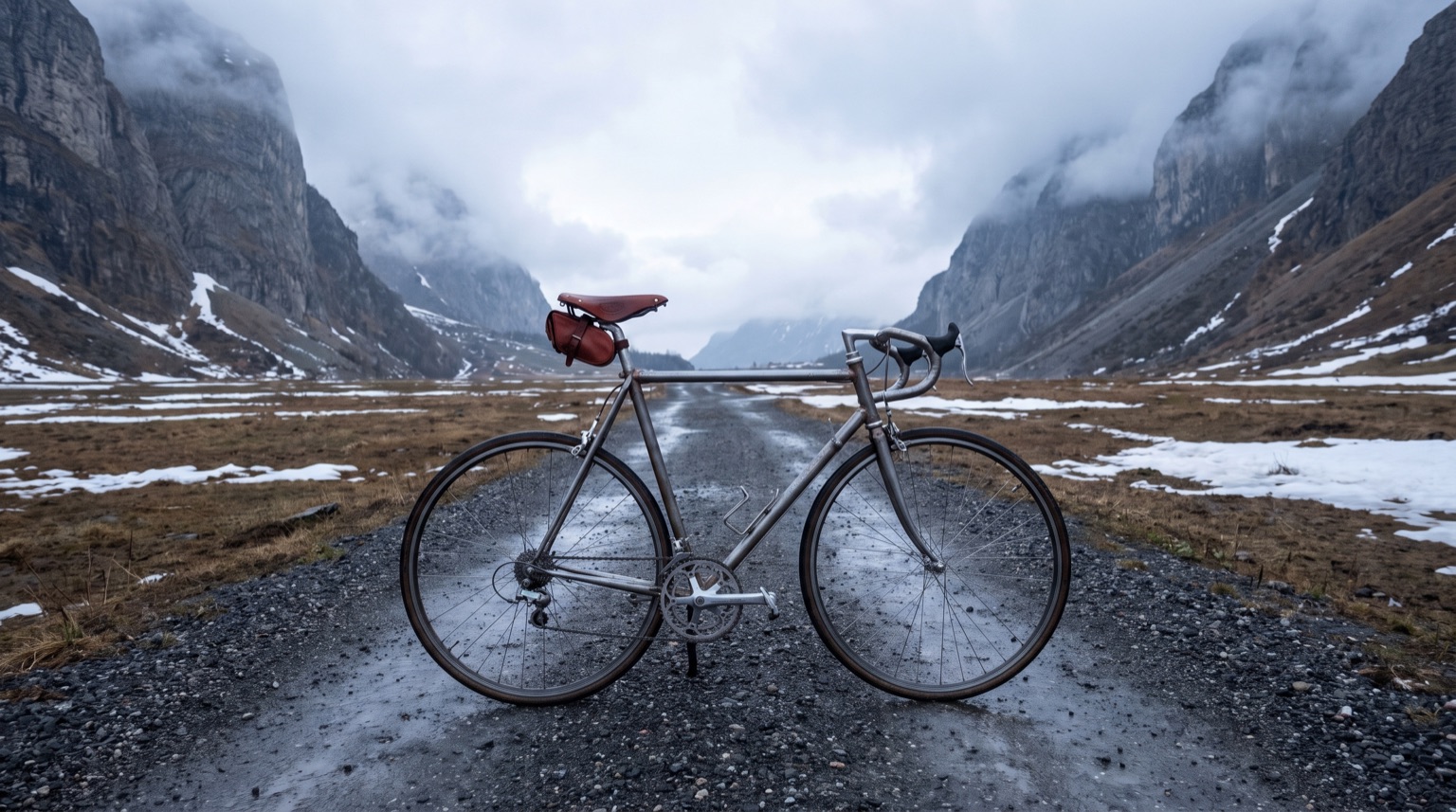
A steel bicycle standing on a wet gravel track in a wide alpine valley, bare rock walls rising into low cloud on both sides.
Valle delle Messi. Where the bianca frames are proved. The surface is the reason those get 38 mm of tyre and twenty millimetres more chainstay than the road frames.

Passo

alpine tarmac · 28 mm

Long paved climbs and the descents off them. Quick without being nervous, because you will be on it for nine hours and two of those are downhill.

Mortirolo, Gavia, Vivione.

Bianca

the white roads · 38 mm

Gravel and broken surface. Slacker, longer in the stays, and carrying enough trail that the front stays put when the surface does not.

Valle delle Messi, the Mortirolo's gravel side.

Randonnée

distance, loaded · 32 mm

Built low-trail for a front bag: the fork is raked far forward so a loaded front wheel still steers itself instead of flopping into the corner.
Anywhere, for twenty hours at a time.
Spessore0,7 – 0,4 – 0,7 mmButted wall thickness, the lightest set in the shop
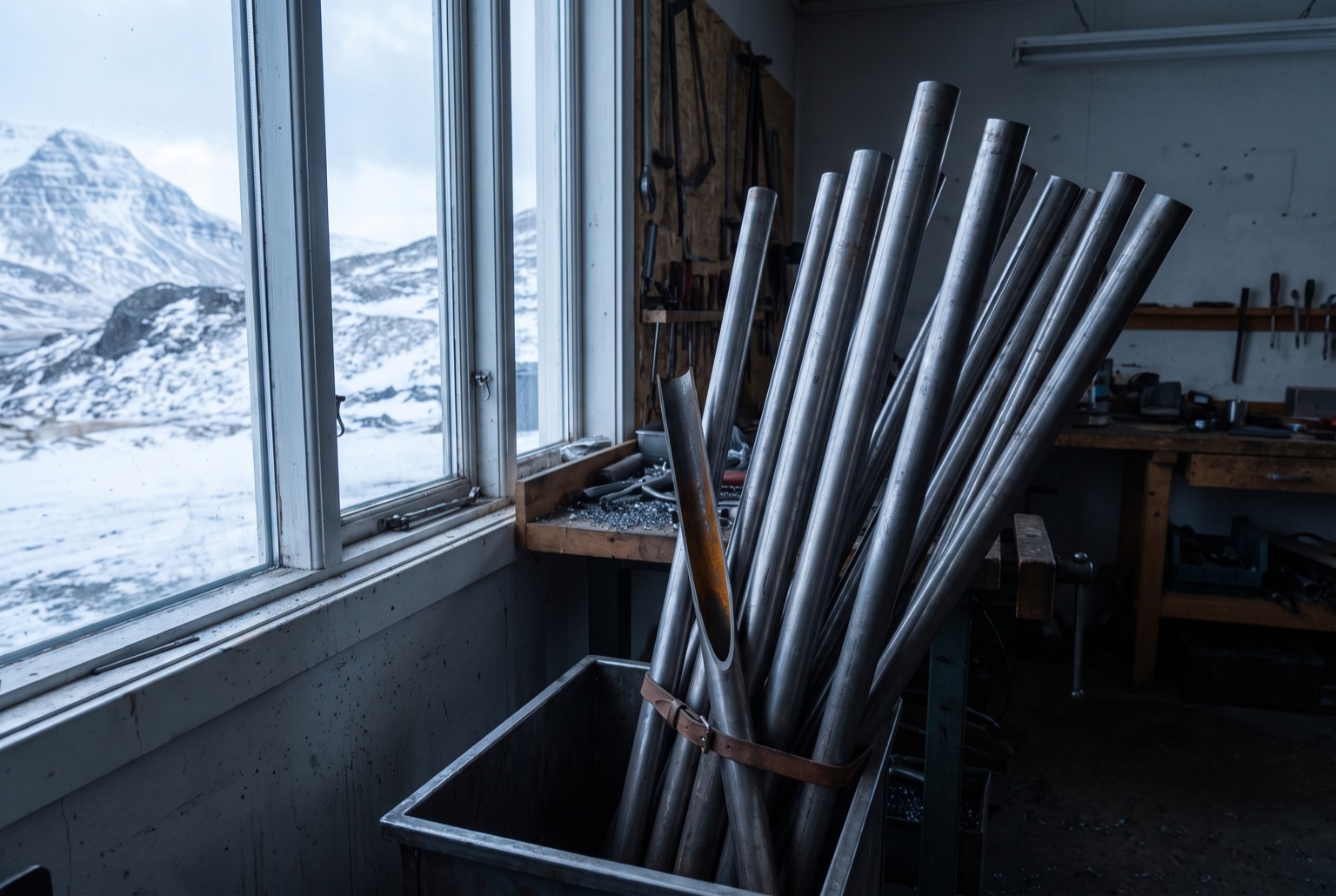
A bundle of bare steel bicycle frame tubes standing in the corner of a workshop beside a tall window, one cut to show its butted wall.
Butted. Thick at the ends where the heat and the load are, thin in the middle where neither is. Four tenths of a millimetre through the centre of a down tube.

Steel, because it can be drawn thin in the middle.

A butted tube is thick where it is brazed and thin where nothing happens to it. That is the whole argument, and it is a manufacturing argument rather than a romantic one.

Wall thickness comes off the rider's weight, not off a catalogue of models. A rider at 58 kg gets 0,7–0,4–0,7 and a frame that weighs under 1 600 g. A rider at 96 kg gets 0,9–0,6–0,9 and is told plainly that the frame is 250 g heavier, because the alternative is a frame that goes soft under him in three years.

He does not build in titanium and he does not build in carbon. Not as a position — he has simply never learned to, and says so rather than inventing a reason.
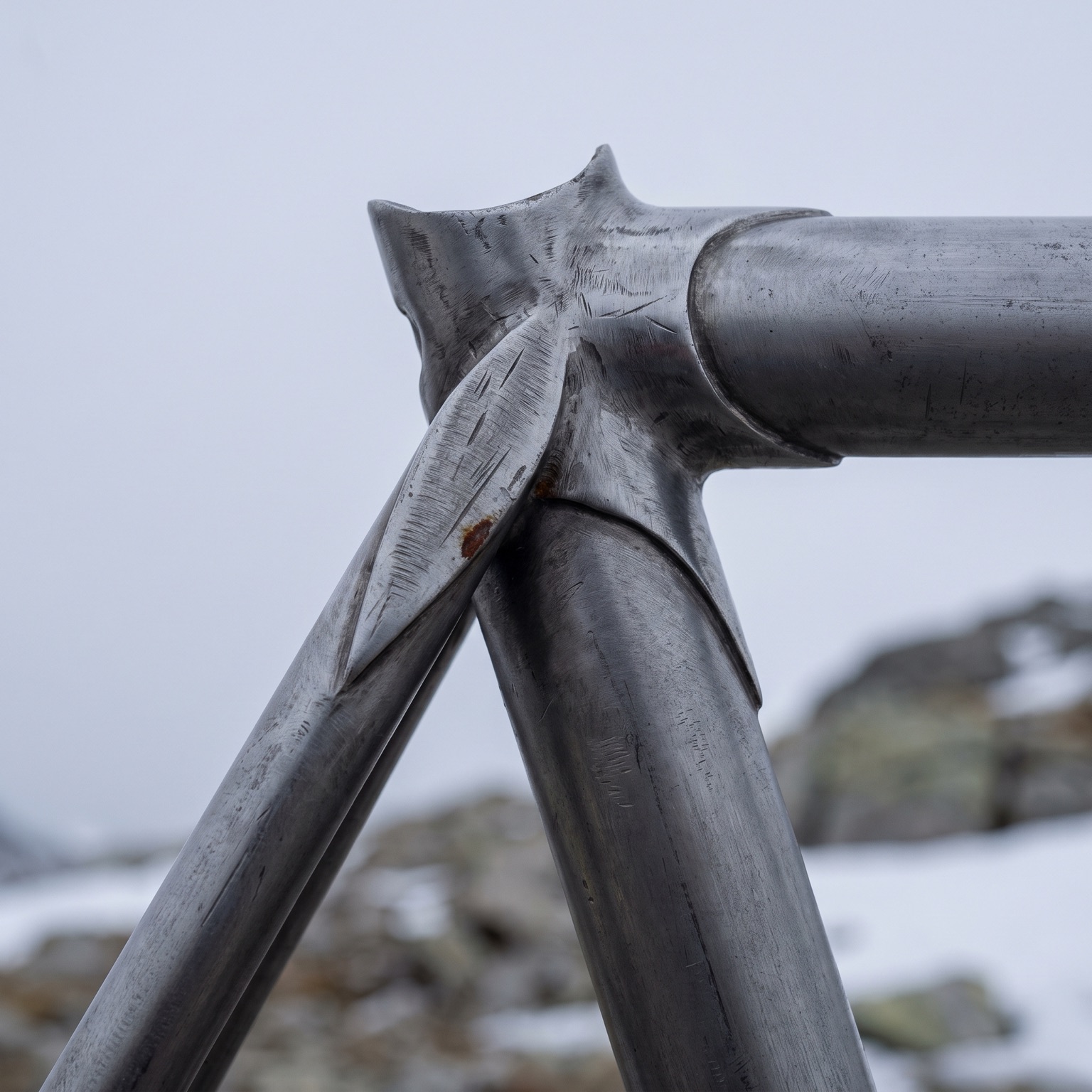
Extreme close-up of a hand-cut steel lug, filed into a tapering spearpoint where two tubes meet.
La congiunzione. The point is filed by hand. It is the only ornament on the frame and the only signature on it.
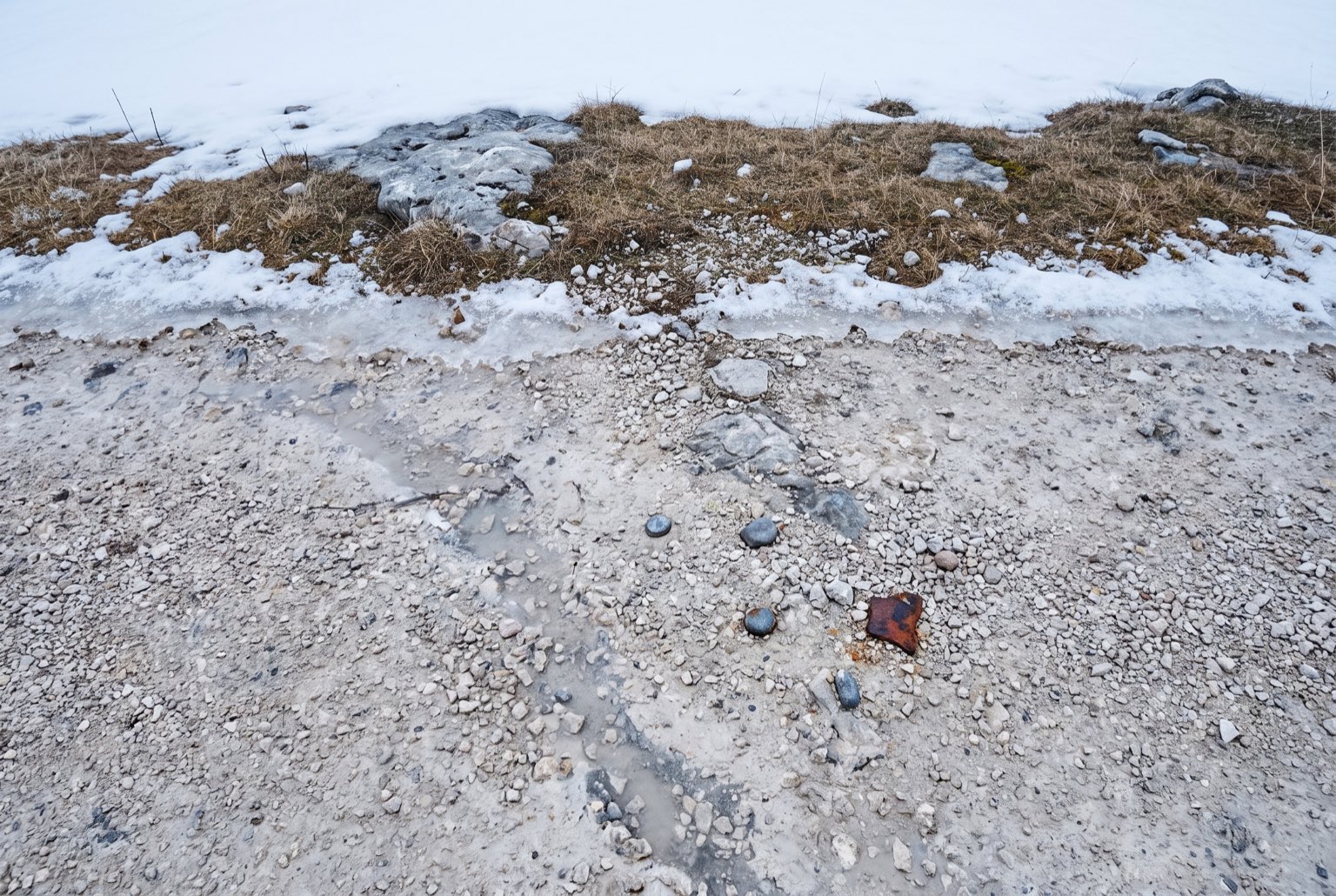
Close overhead view of a coarse pale limestone gravel road surface, wet from melting snow, with old snow at the verge.
La ghiaia. Limestone, wet, and loose on top of hard. This is the surface the 38 mm number comes from.
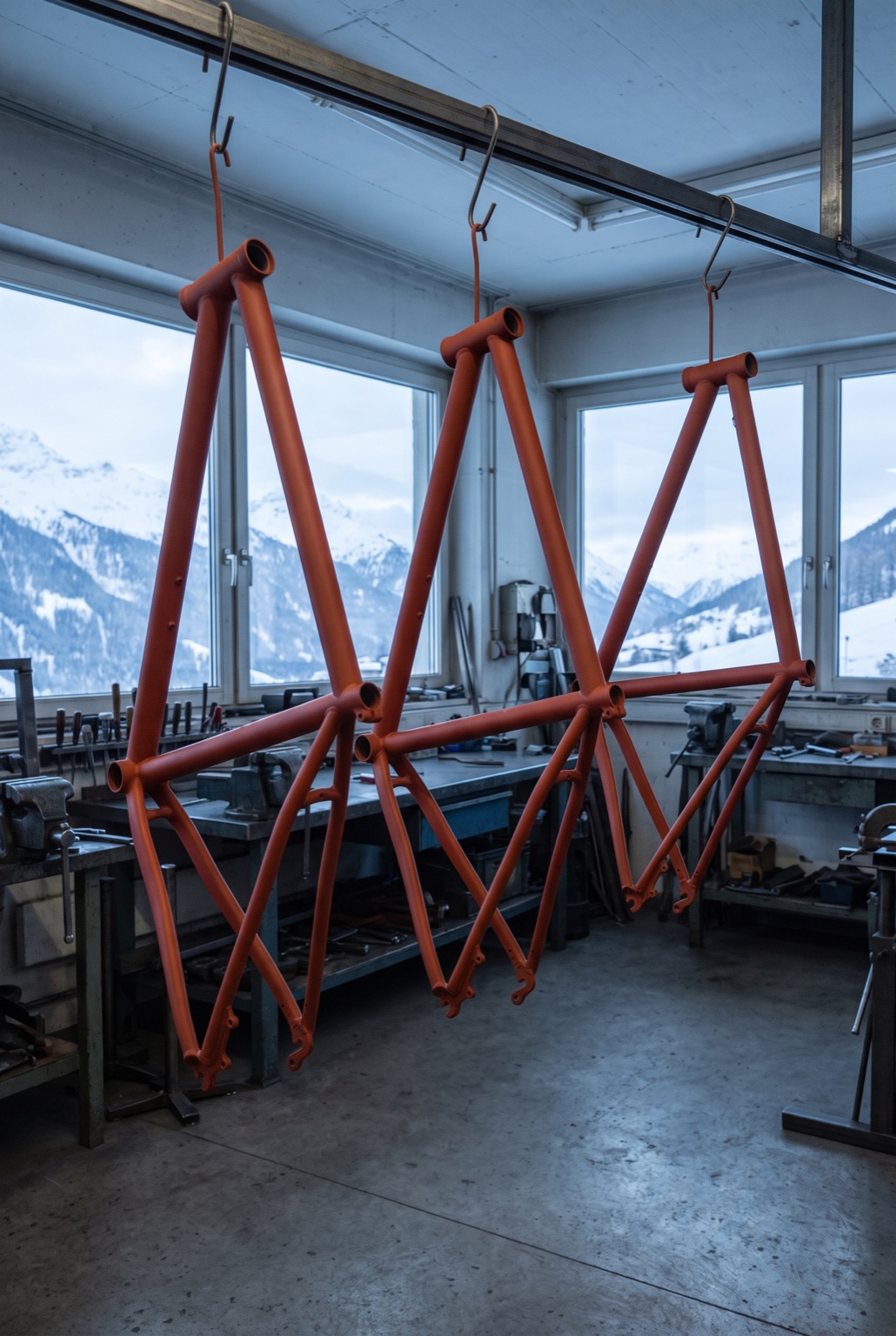
Three bare steel bicycle frames in matte orange-red lead-oxide primer hanging by their head tubes from a rail in a bright workshop.
Il minio. Red-lead primer, the only colour in the shop. Paint happens down the valley in Brescia; he does not do it and does not pretend to.
Angolo sterzo71°30′ – 73°30′The range this drawing moves through

Your numbers, your road, drawn to scale.

Five things decide a frame, and two of them are about you. Change any of them and the drawing below is redrawn: angles, trail, wheelbase, weight and price together, because on a bicycle they are not separate decisions.

Sets the top tube. It is the number everyone gives and the less useful of the two.

178cm

Sets the seat tube. Two riders at 178 cm can be 8 cm apart here, and they do not get the same frame.

84cm

Chooses the wall thicknesses. Nothing else on this page depends on it and nothing else should.

74kg
La strada the road

An input, not a preference. It sets the tyre, the stays, the drop and, most of all, the fork.

Allungo reach

Twelve millimetres either side of the length he draws unless told otherwise.

A scale side elevation of the frame: seat tube 546 millimetres, top tube 561, head angle 72°48′, seat angle 73°42′, trail 57 millimetres, wheelbase 998 millimetres, on 28 millimetre tyres. Toe clearance: on the edge, 2 millimetres.+ 2 mmavancorsa 57 mmpasso 998stack 524reach 408sterzo 72°48′piantone 73°42′

Drawn to one scale throughout, so a small frame is drawn small. The dashed line through the head tube is the steering axis, and the gap between where it meets the road and where the tyre does is the avancorsa, the one number on a bicycle nobody can point at.

Sterzo / piantone
72°48′ / 73°42′head and seat angle
Avancorsa
57 mmtrail
Passo
998 mmwheelbase
Piantone / orizzontale
546 / 561seat and top tube, mm
Stack / reach
524 / 408from the bottom bracket, mm
Tubi
0,8 – 0,5 – 0,81635 g
Al limitesovrapposizione · on the edge

2 mm. Clear on paper and not clear in winter overshoes. Say what you ride in and he will draw it either way.

Aprire l'angoloslacken the head angle

The front wheel goes further out, the overlap goes away, and the steering slows. On a frame this size that is a real change in how it turns, not a detail.

Gomma più strettaa narrower tyre

Buys back a few millimetres and gives up the surface you chose the frame for. It is the answer that undoes the specification.

Tenerlalive with it

It only ever touches below walking pace, turning hard. Every rider his size has it, including him. This is what he recommends.

€2.850frameset — frame, fork, headset faced and fitted
Comincia questo telaio
Allineamento± 0,3 mm sul pianoThe tolerance the shop actually holds, measured on every frame

Mitred, brazed, and then argued with on a cast-iron table.

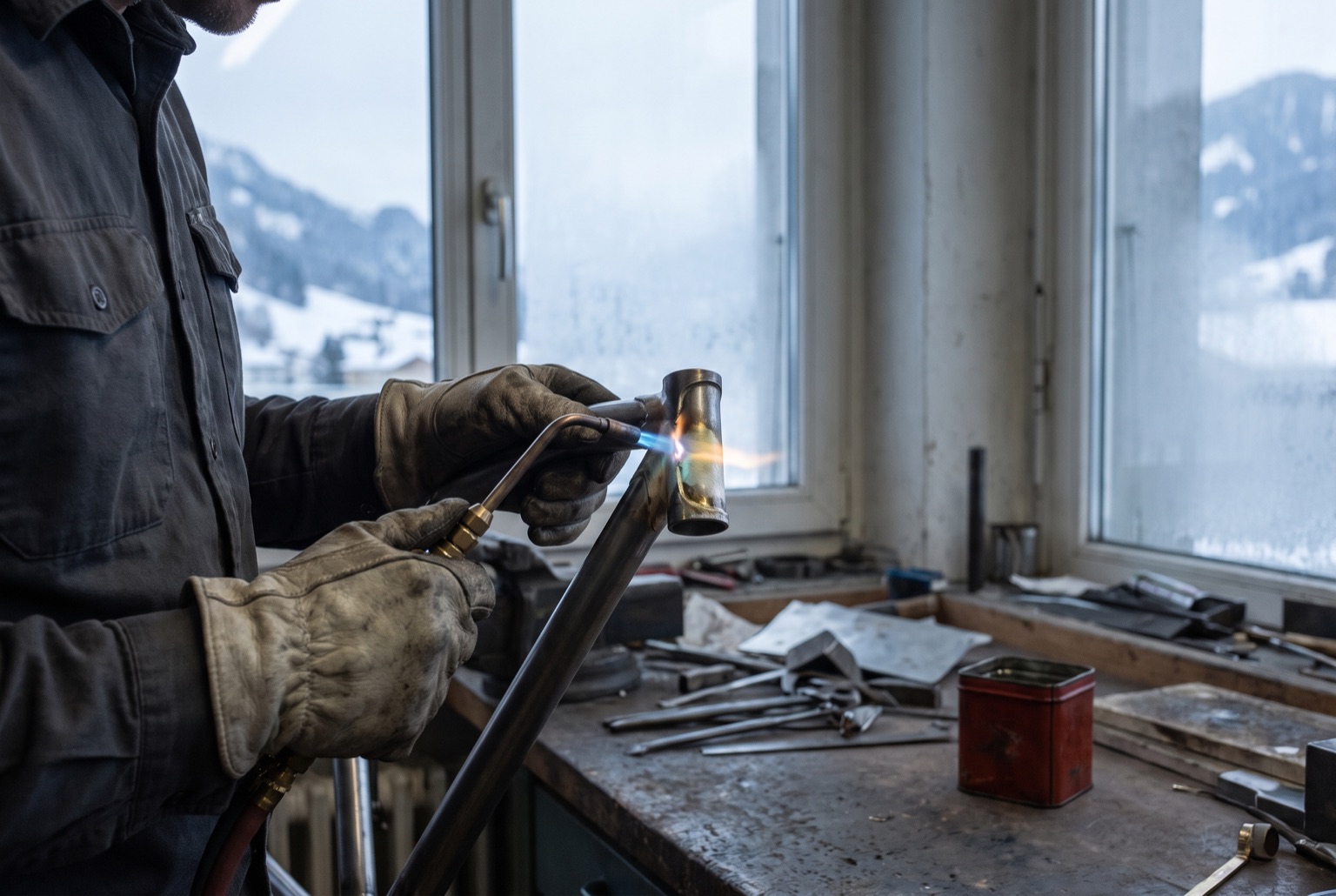
Brazing pulls steel. Every frame comes off the jig out of true, and the work is knowing by how much before you measure it.

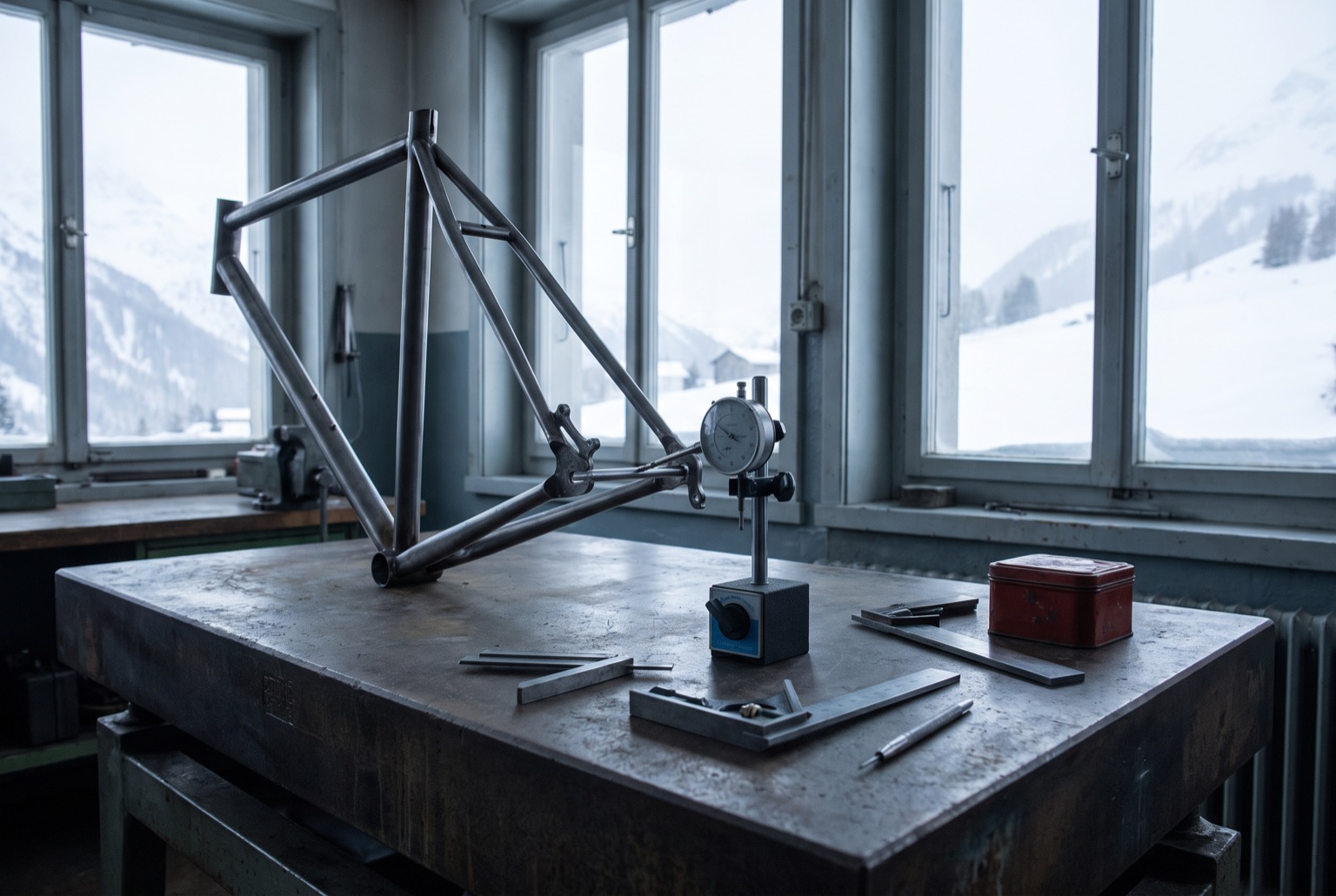
Tubes are mitred to the drawing, tacked in the dima, then brazed with brass at around 870 °C: hot enough to flow, not hot enough to burn the tubing's heat treatment. Then it goes on the piano di riscontro, and it is cold-set by hand until the dial reads inside three tenths of a millimetre.

Thirty-four hours in a frame, and eleven of them are filing. Not because filing is romantic. Because a lug that is not thinned at its edge leaves a hard line in the steel, and hard lines are where frames crack.
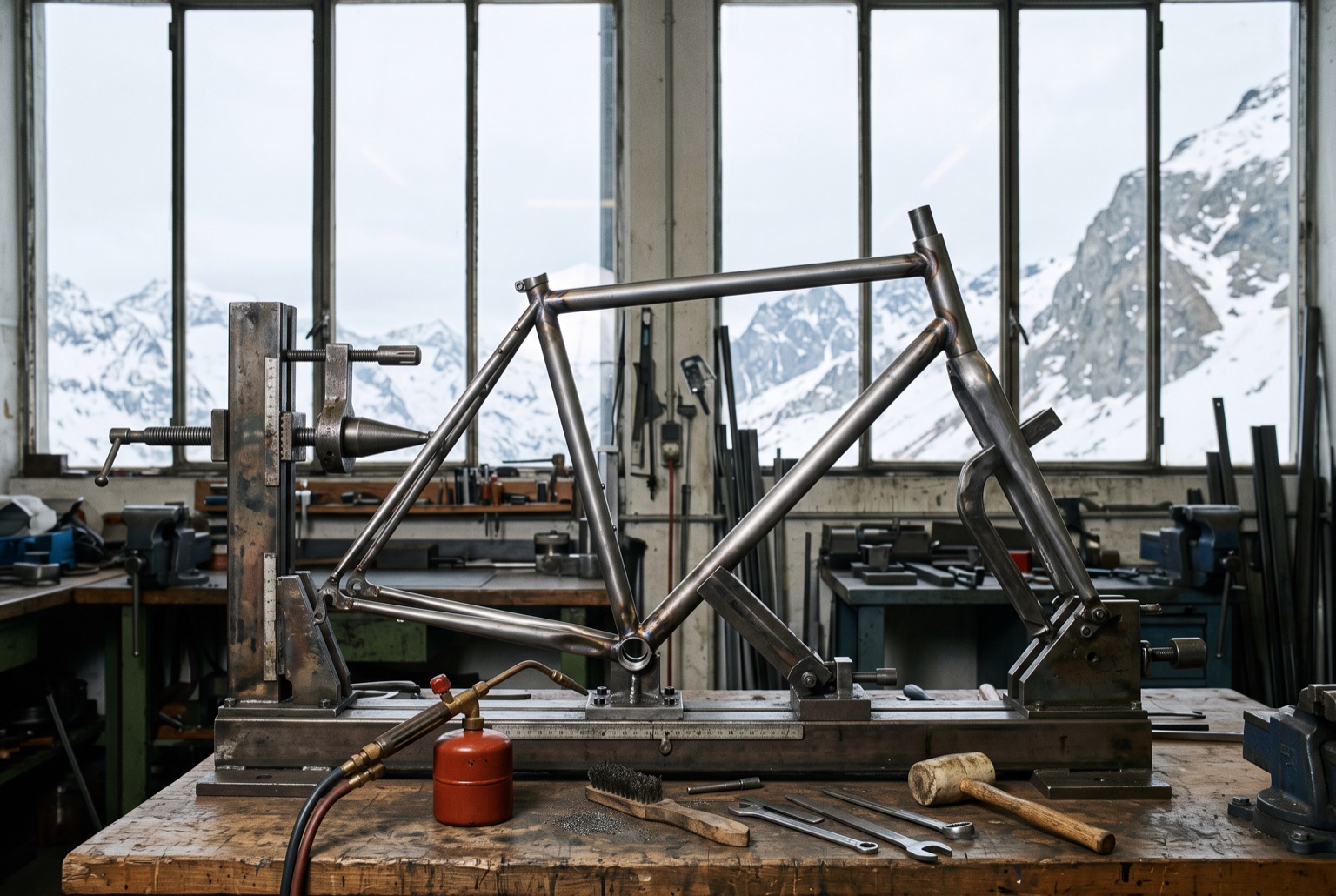
A tacked steel bicycle frame held in a heavy adjustable steel frame-building jig on a workbench, snowy peaks visible through tall workshop windows.
La dima. The jig holds the drawing while the heat tries to take it away.
Gloved hands guiding a small brazing torch around a steel bicycle lug, brass filler flowing into the joint.
La brasatura. Brass, not silver, on everything except the stays. The flame is the only warm thing in the building.
A bare steel bicycle frame lying on a cast-iron surface plate with a dial indicator gauge set against the rear dropout.
Il piano di riscontro. The frame is wrong until the dial says otherwise, and the dial is right about twice out of three.

± 0,3 mm

Every frame leaves with its measured alignment written on the underside of the bottom bracket shell in pencil, where the paint will not reach it. If yours reads 0,25 that is what it read on the table, and if it reads 0,4 he will have told you before you saw it.

Ore34 al telaioHours in one frame; eleven of them filing

One bench, and about twenty-six frames a year.

He took the shop from his father in 1994 and has not taken on a second builder, which is a decision about how many frames exist and not a decision about quality.

He cuts, mitres, brazes, files and aligns every one himself. He does not paint them. Painting is a trade, it is not his, and the man in Brescia who does it has been doing it for thirty years. He will tell you that in the first conversation, usually before you have asked.

The waiting list runs to fourteen weeks and he does not take deposits to hold a place on it, because a deposit makes it harder to tell someone their frame is going to be late.
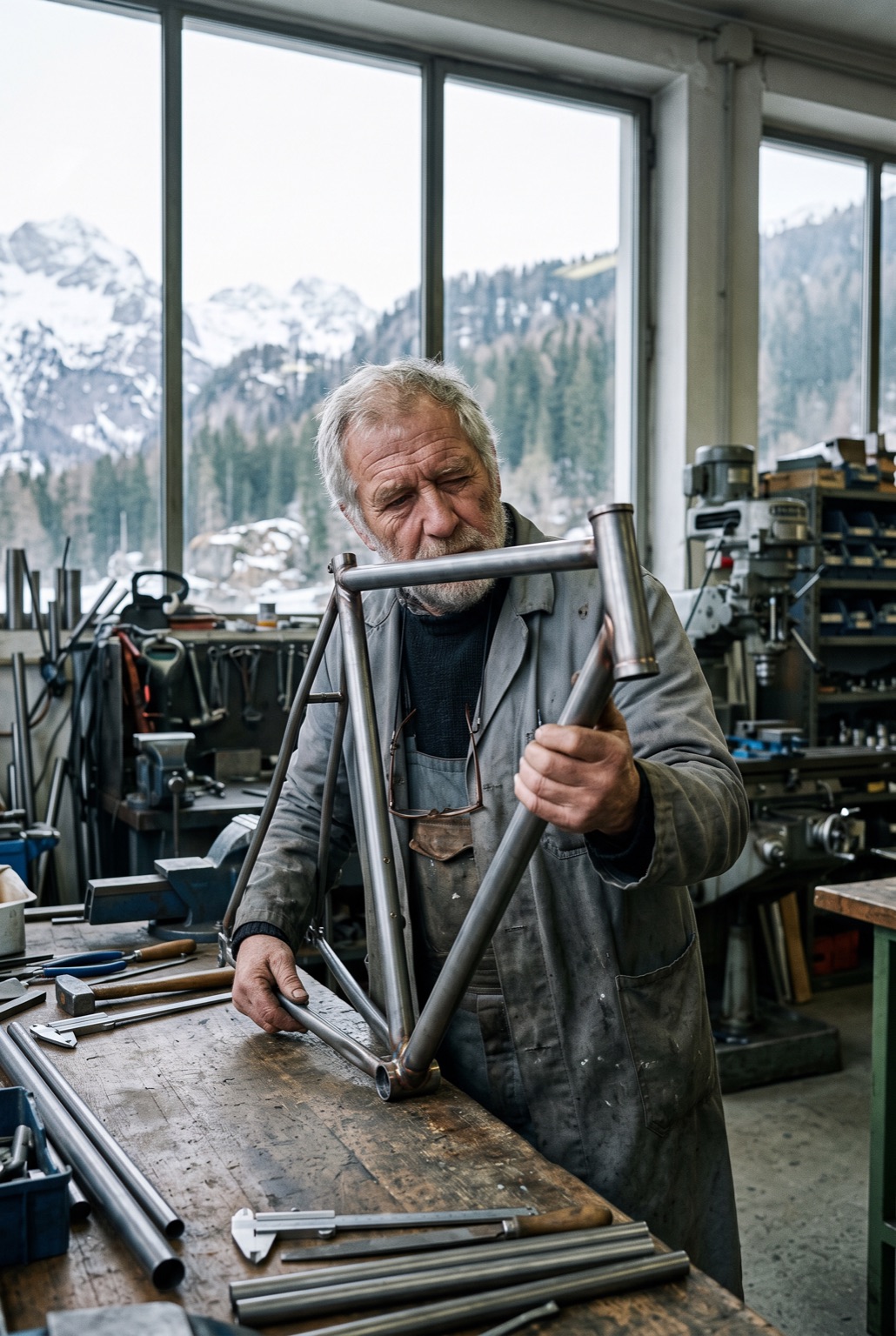
An older craftsman in a grey work coat holding a bare steel bicycle frame upright and sighting along its length, snowy mountains through the workshop windows behind him.
Sighting the frame. Before the dial gauge and after it. He has been wrong about what he sees roughly as often as the table has.
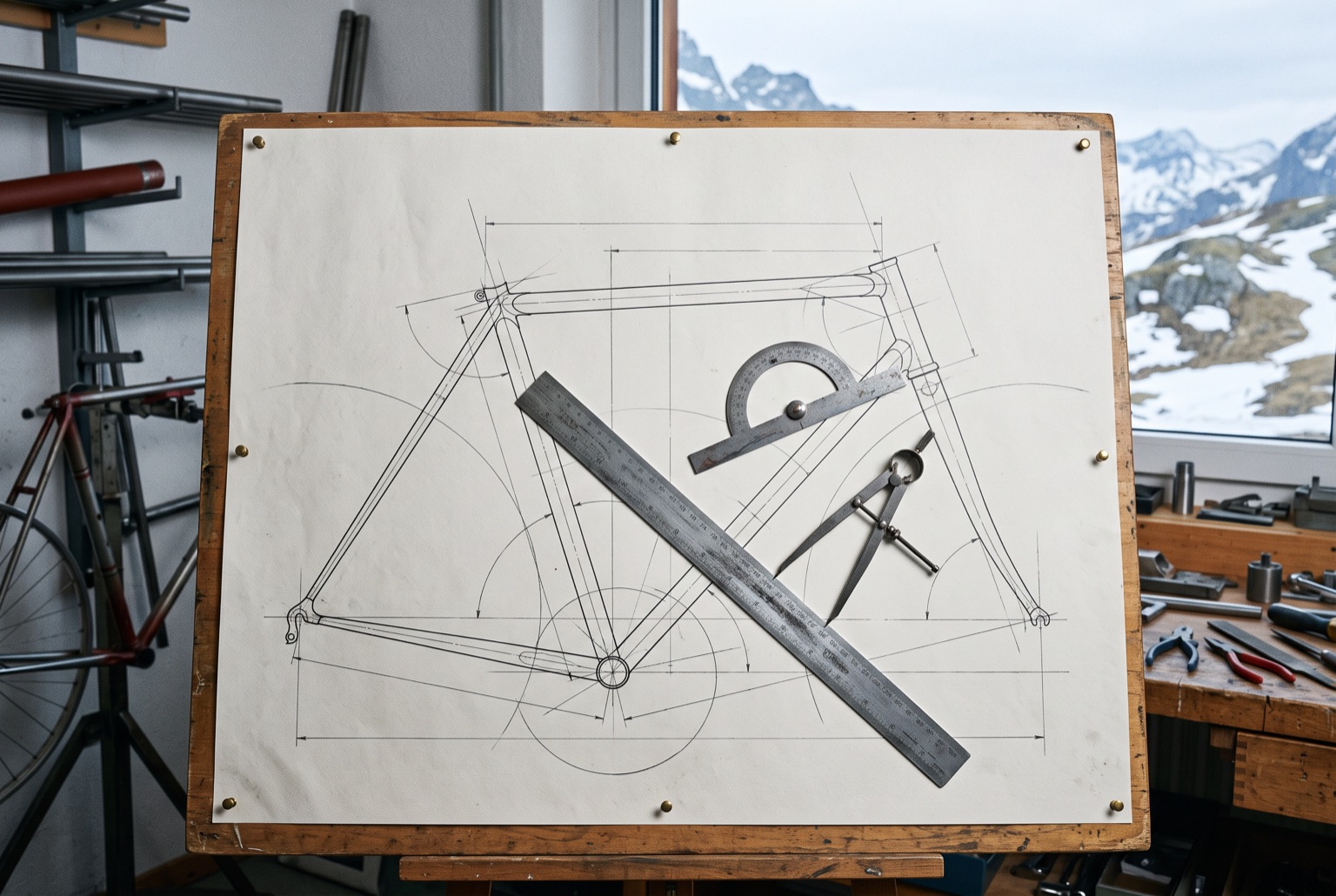
A full-size bicycle frame geometry layout scribed in fine lines on a large sheet of paper pinned to a drawing board, with a steel rule, protractor and dividers across it.
La traccia. Every frame is drawn full size on paper before a tube is cut, at 1:1, so that the angles are argued at the size they will be ridden at. The drawing above on this page is the same drawing, done faster.
Attesa14 settimaneStated before you ask for it

Starting one.

The specification below is the one you drew. Send it and he will write back once with what he would change about it and why — that reply is the actual beginning of the frame.

He needs something to write at the top of the sheet.

One reply, with what he would change. Nothing else, ever.

That address will not take a reply. Check it and send again.

The town, and what the roads there are actually like. This changes the frame more than anything below it.

Say where. It is the input he trusts most.

Injuries, a frame you already like, a saddle height you know works, a date you need it by.

Opens your own mail and sends an order request. No card, no payment, no deposit.